Monday 17 June 2013

Anne Frank House

Though I mostly bookmarked places in Amsterdam to return to another time, I did find time to visit the Anne Frank House - which is, as most people will know, the preserved building where Anne, her family, the van Pels family and a man called Fritz Pfeffer hid during the Nazi occupation of the Netherlands.  The heart of the museum is the suite of rooms (the 'secret annex') where the eight hid.

One practical hint: though the line outside appears very long, it did move swiftly.  The ticket office is actually in a neighbouring building (you pay a small admission charge) and there's also an orientation area with a short film about the events leading up to the occupation and the impact it had on Dutch Jews.  Then you move through into the building proper.

Photography is not allowed (not that it felt particularly appropriate to take photos) and, in any case, you don't need photos if you've ever read Anne Frank's Diary.  What I had both expected and dreaded turned out to be true: the house is exactly as Anne describes it.

Walking through the offices of Otto Frank's business helps to prepare you a little bit for what's to come: there are interviews with his employees who undertook to help the families hide.  There's also the surreal experience of looking out the window at the canal - the epitome of gracious, ordered Amsterdam and hearing about people being hunted like vermin.  But then, it must have seemed surreal to the Jewish citizens of Amsterdam, too.

From the offices you go upstairs and encounter one of the famous secret doors of literature.  Except that there are no friendly fauns or Turkish delight on the other side of this one: just six small rooms (if you can even call all of them rooms) and a cubby hole under the staircase.  My memory from reading the book as a teenager was an overwhelming feeling of claustrophobia.  Now that I've been in the space I think I should multiply that by a thousand.  It is almost inconceivable that people stayed in this small space for so long with only the briefest glimpses of the outside world.  The attic (used for storing potatoes) where Anne spent much of her time is like a kind of heaven above the other rooms - at least there was a window in it.

Visiting the Secret Annex reminded me of the other strong feeling I had on reading the book - that sense of grief that the hiding, the claustrophobia, the heroic efforts of the 'helpers' were, ultimately, in vain.  Of the eight people who hid, only one, Otto Frank, survived the Holocaust.  There are heartbreaking stories of his search for his daughters after the war and of his decision to publish Anne's book.  Anne was in fact a prolific writer and several copy books and manuscripts of diaries, stories and other writings are on display, including one of 'the' diaries.

When I said that I dreaded discovering the house and the annex were just as Anne described, this is why: reading a book, you can sometimes pretend to yourself that it's just a story ... details are changed ... facts embellished.  But when I visited the Anne Frank House I had to accept that, in the words of one of my favourite poems*, 'the story is true'.

*Robert Creeley, 'Bresson's Movies'

Thursday 6 June 2013

Bookmarking Amsterdam

I visited Amsterdam last month and was charmed.  It was just after the inauguration of King Willem-Alexander and the buildings were still decked out in patriotic colours, with photos of the new king and queen all over the place.  I was in Amsterdam to work, so my excursions were more in the spirit of bookmarking: noting places I want to revisit next time I'm here (and there will be a next time, of that I'm sure).

I noted lots of street art, 


walked along the canals - particularly in the Nine Streets area,


and took lots of photos of tall, thin canal buildings.  Including several - interesting museums.


I didn't have time for much shopping, but I did buy my little sister a big block of cheese.  Check out this shop - you could smell it from the end of the street!


Everywhere, there were interesting things that caught my eye.  This photo friendly memorial to Rembrandt, for example,


or these plaques outside the Amsterdam Museum.


Perhaps my favourite stumble-upon was this - I had noted on my map some oddly tulip-shaped icons, but didn't work out what they were until I more or less walked into the floating flower market.


Amsterdam, you were interesting and friendly and I can't wait to go back and browse in your Delft tile shops (I had a quick poke in one - exquisite tiles dating back to the 17th century!  Amazing.) and eat more cheese and wander the canals and go to the Van Gogh Museum.  Please save my place for later.

Wednesday 5 June 2013

Overseen: See, Read, Fly

Overseen in Amsterdam Schiphol Airport, May 2013.  The library is part of the Dutch public library system and includes books on Dutch history, culture, people - with extensive (and very comfortable) seating.


It certainly beats killing time in Duty Free.  

See this article in the New York Times or follow @airprtlibrarian to find out more.

Monday 27 May 2013

Al Ain

Hi.  Hello there!  Remember me?  Yes, it has been an awfully long time since I posted - I blame a new job and an impromptu trip to Australia and then the ensuing guilt which gave me blogger's block and prevented me from posting these very overdue photographs from when I visited Abu Dhabi back at the beginning of March.  But let's move past all of this and get on with the show.  Today it includes coffee, palm trees, oases and camels.  

On the second day of my 48-hour sojourn in Abu Dhabi I elected to go to the oasis city of Al Ain to get more of a feel for traditional Emirati culture.  Given my time was limited, I booked a day trip with Desert Rose tours - great decision, as it turned out.  Friendly, courteous, knowledgeable driver and much the best way of visiting a few sites in one day.

First stop: the Palace Museum, former home of the founder of the UAE, Sheikh Zayed Bin Sultan Al Nahyan.


The palace interiors are cool, simple but rather beautiful.


This rather intriguing piece of equipment was (I think, it's so long ago that I'm hazy on the details) for climbing date palms,


while this is a typical seating area with coffee making equipment down in the bottom right hand corner.


In the women's quarters, I was very taken by this suspended, swinging hammock/cot - especially since friends of mine just bought something similar for their new baby.


And here's me in the majlis, the formal reception area of the palace.  To the manner born.


This sitting room was in the palace's guest quarters.  I do covet the blue-embroidered coverings - and the beautiful rug.


From the palace, we went on to the oasis, around which the city has grown.


As well as date palms, we saw oranges,


and these palm-dappled networks of irrigation channels.


I was interested to see some mosques hidden among the trees; several of them, tucked into small clearings in the trees.  I assume they were/are for handy access of people labouring among the palms.


Next stop: the camel market.


Oh! A baby camel ... which costs upwards of €3000.  So I didn't bring him home.


Or this one, though she did her best to charm me.


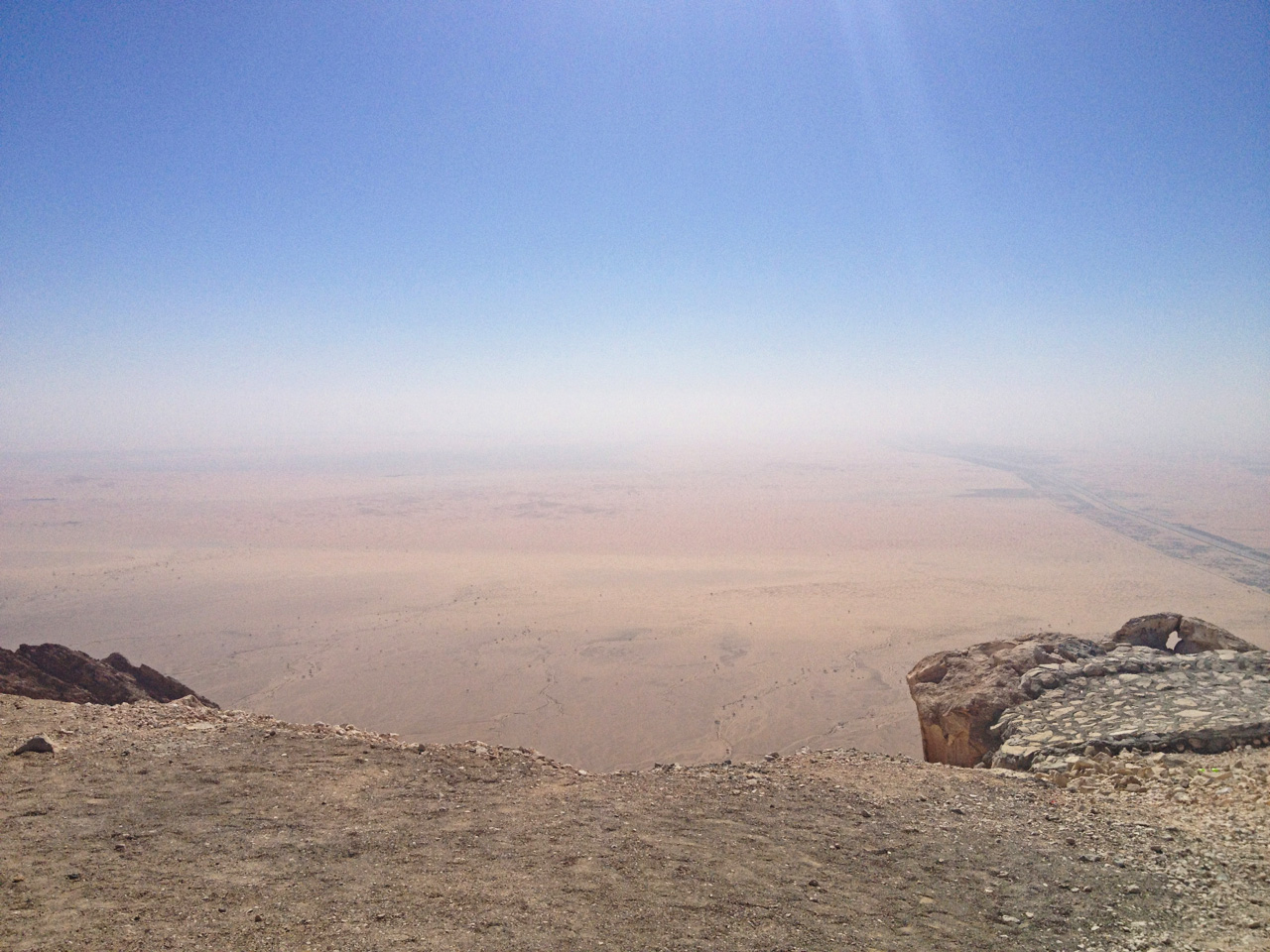
Our final stop was Jebel Hafeet, one of the highest mountains in the UAE.  We drove to the top (I asked the driver if many people hiked on/up the mountain.  He looked at me blankly.  'But there's a road,' he observed, perplexed.  'For cars.') from where you get a wonderful view of the desert.


This is a great picture to remember Abu Dhabi by - and yes, it was well worth the stopover.  I very briefly touched down in Abu Dhabi airport on my way to Australia at the beginning of May and very much regretted I didn't have time to go back to the oasis or to sit in a courtyard and eat mutabel with pomegranate seeds.  Oh well - next time.

Friday 12 April 2013

UAE Hints and Mosque Manners

Herewith a few hints to Lady Travellers visiting the UAE on their own.

First of all, I didn't experience any particular problems as a woman on my own in Abu Dhabi.  Everyone I met was courteous and friendly and, as far as Western women are concerned, the rules concerning dress are fairly liberal.  I chose to wear tops that covered my arms and trousers - but this was partly as protection against the sun.  However, I've found that when you are on your own, dressing more conservatively offers some protection against unwanted attention (though it didn't stop two guys from making kissy faces at me outside the souq - for them I employed my Cape Town Mean Face).

The one exception to the dressing rule comes when visiting a mosque.  The Sheikh Zayed mosque helpfully advises visitors as to appropriate clothing:


Briefly, upper arms and legs need to be covered for men; hair, arms and legs for women - and clothing shouldn't be too tight.  Clothing with profanity on it is also a no-no. I wore cotton trousers and a long-sleeved cotton shirt and had brought a scarf with me and this proved to be entirely acceptable.  (I'm frowning with the effort of photographing myself.)


BUT, but, but, if you turn up not wearing suitable clothing, Sheikh Zayed Grand Mosque will supply you with a robe to put on over your clothes (I imagine this is not the case with smaller, less tourist-friendly mosques, however).

You will be required to take off your footwear before entering the mosque proper.  I also noticed one couple who were being photographed by a friend (not a problem) being politely asked not to touch inside the mosque.

Apart from that, the same rules apply as when visiting most places of worship: be respectful and think twice before photographing people at prayer.

Thursday 11 April 2013

Abu Dhabi: A Mosque and a Souq

I stopped off in Abu Dhabi on my way home from Australia because a) it's a long journey and it's more pleasant to get off the plane and go to a hotel than to get straight onto another plane, b) because I was curious to visit the UAE and c) because I'd never visited and could count it as my new country for 2013.  (These reasons are in no particular order.)  

With only 48 hours in Abu Dhabi (and being fairly jet lagged) I focused on a few key things I wanted to visit.  The first was the Sheikh Zayed Grand Mosque which we passed on the way from the airport to my hotel.  In the sunrise all of the domes and minarets were tinted a rosy pink.  When I visited later in the day, everything was blindingly white - I literally had to put on my sunglasses to see properly.

The building of the Mosque was initiated by Sheikh Zayed bin Sultan al Nahyan, the 'father' of the UAE, and he is buried in its grounds (though access to the mausoleum is limited).  It is one of the largest mosques in the world and a great source of pride to the Emiratis I met.


Inside, there is lavish attention to detail.  Flowers inset into the marble floors,


and floral motifs creeping up the walls, not to mention the windows.


The carpets were equally stunning - and because, it being a mosque, all visitors have to go barefoot inside, you really experience the thick pile first hand.  First foot?


The scale of the Mosque is fairly breathtaking and visiting was a fascinating experience - although I found its size overwhelming.  It would be interesting to see whether, as it ages, it develops a patina like, say, the Taj Mahal.  But sadly none of us will be around in 400 years to compare notes.

After leaving the Mosque, I went downtown to the Souk/Central Market, a Norman Foster-designed reimagining of the traditional souk.  There's a nod to tradition in the use of materials, the latticing and the play of light in the interior.


Inside, there are clothes shops, many jewellers, several souvenir shops and, my favourite, an emporium of spices, teas and dried fruit.  I particularly loved the baskets outside - look how beautiful this display is.


I had a real wow-I'm-really-in-the-Middle-East-now moment when I peered at this (greyish, unappealing substance) and realised that it was frankincense.  It smells (forgive me for any inappropriate smell-association) like all the incense burners of all the Catholic masses of my youth.  When I looked into it, I discovered that frankincense is often used for incense in Catholic churches.  So there it was - exotic and faintly nostalgic, all at the same time.


Slightly less exotic, but amusing to see, was the shop next door to the souq:


Apart from these two iconic experiences, I wandered around a little, taking in the newness of it all - both new to me and new in the sense that a great deal of downtown Abu Dhabi is very new.


I thought I'd hit upon an ancient monument when I saw this:


But sadly it was on a hoarding covering the building within and access to the actual fort is currently forbidden owing to building works.


So I called it a day and went back to my hotel to watch camel racing on tv and to marvel at the intricate and stylish ways in which the female tv presenters on the local and on the Saudi Arabian channels arrange their hijabs.  

Wednesday 10 April 2013

Overseen: Matchy Matchy

Overseen in Marseille, March 2013.  Oh those French, with their matching vans and window treatments.