Showing posts with label guided tour. Show all posts

Friday 17 October 2014

The Poetical Walls of Leiden

For the past year or so, I've been working on a project in beautiful Leiden, home of the oldest university  in the Netherlands.

A couple of weeks ago, we went out for an evening stroll along the canal and I spotted this house.


I assumed the residents were just big Shakespeare fans.  Why NOT paint Sonnet XXX on the side of your house?  Good idea.

But then I also saw this house and realised that it wasn't just a once off, but a project to transform buildings into outsized pages of poetry.


And here's another one.


It turns out these 'wall poems' are part of an ongoing project, and rather than being temporary, they remain for everyone to find and enjoy.

Lovely idea, no?

If you should find yourself in Leiden, the project website has a full list of the poems (107 and counting) and a map, so you can design your own walking tour.


Thursday 14 August 2014

Around Arranmore

If you're wondering what there is to do on an Irish island, the answer, most often, is walk around and look at the scenery.  One of the most striking things about the scenery on Arranmore is the contrast between the east and west sides of the island.  The sheltered east side is almost lush (or certainly lush in comparison) with trees, bright flowers - and bright paint.  The west side, exposed to the Atlantic and with nothing between it and America, is wilder, more rugged.  I can confirm this, because we walked all the way around the island, 14km in total.  We followed Slí Árainn Mhór or the Arranmore Loop from Aphort at the south-eastern end of the island, walking clockwise till we came back to where we started - with a brief detour to Phil Bán's Pub.


Monday 4 August 2014

The Layers of Thessaloniki

When I was in Thessaloniki at the end of June, one of the highlights of the visit was a walking tour of the city.  Our guide was called Romulus (yes, really) and in just a few hours he helped us at least to begin to make sense of the layers and layers of the city's history.

Often archaeological sites put me in mind of Shelley's Ozymandias - 'Look on my works, ye mighty, and despair! - a reminder of impermanence, that our grandest monuments and most beautiful buildings will one day crumble.  But sometime they are a reminder of endurance: despite wars and weather and wear, fragments of the past survive and are made new.  Thessaloniki is an excellent example of the latter - but before we get to the evidence, first a brief history.

Thessaloniki means 'Thessalian victory', and the city is named for the half-sister of Alexander the Great, Princess Thessalonike.  I touched on this here, but it is a city that has endured a great deal and yet has survived.  An important city under Alexander, Thessaloniki then became an administrative capital of one of the four quarters of the Roman Empire.  (I'm skipping a few centuries here: this is the highlights tour.)  After the fall of Rome, Thessaloniki was, perhaps, even more powerful within the Byzantine Empire, second only to Constantinople.  From the 15th century, the city was ruled by the Ottomans and became the proverbial melting pot - home to Muslims, Orthodox Christians, Catholics and Jews.  It wasn't until 1912 that the city was claimed by Greece and during World War I became a base for the Allied Powers.  The old city was devastated by fire in 1917 - and, adding to the huge upheaval, came the population exchange between Greece and Turkey in 1923. Given that Thessaloniki seems to have suffered everything a city can suffer, you won't be surprised to hear that during World War II it was attacked by the Italians and invaded by the Germans, resulting in the deportation and death of most of the city's Jewish population.  And yet - despite all of this, despite the Greek Civil War, despite the recent economic crisis - Thessaloniki is still there, still beautiful.

Walking through Thessaloniki, you begin to distinguish evidence of different centuries.  Starting with the 21st century at the harbour,


through the 20th in the Art Deco apartment buildings and hotels,


not to mention the former stock exchange.

Stepping into the market you could be in anytime over the past hundred years or so,


but the churches are unmistakably Byzantine.


And - not looking incongruous at all - is this Byzantine-style former mosque.


In the crypt of St Demetrius' Basilica is the place where the saint is supposed to have been martyred,


but which also contains inscriptions in Arabic and Hebrew.


Digging deep gets to some of the oldest layers: here is the palace of Galerius, one of the Roman rulers of Thessaloniki.


Those boxes scratched on the stone are, quite possibly, the remnants of a game played by slaves to pass the time while they waited for their masters.


Galerius also had an arch constructed - which, known as the Kamara, is still a popular meeting meeting place for Thessalonikans.


And here is the Rotunda - which captures the city's adaptable nature.  Built possibly as Galerius' mausoleum, or a pantheon, it has since done service as a mosque and a church and a concert hall (a couple of those at the same time.)


So there you have it: Thessaloniki, city of layers.  


And if it all seems a little exhausting, you could do worse than to do as we did after our walking tour - take yourself to one of the city's pastry shops and dive into the sticky layers of some baklava.

Monday 7 July 2014

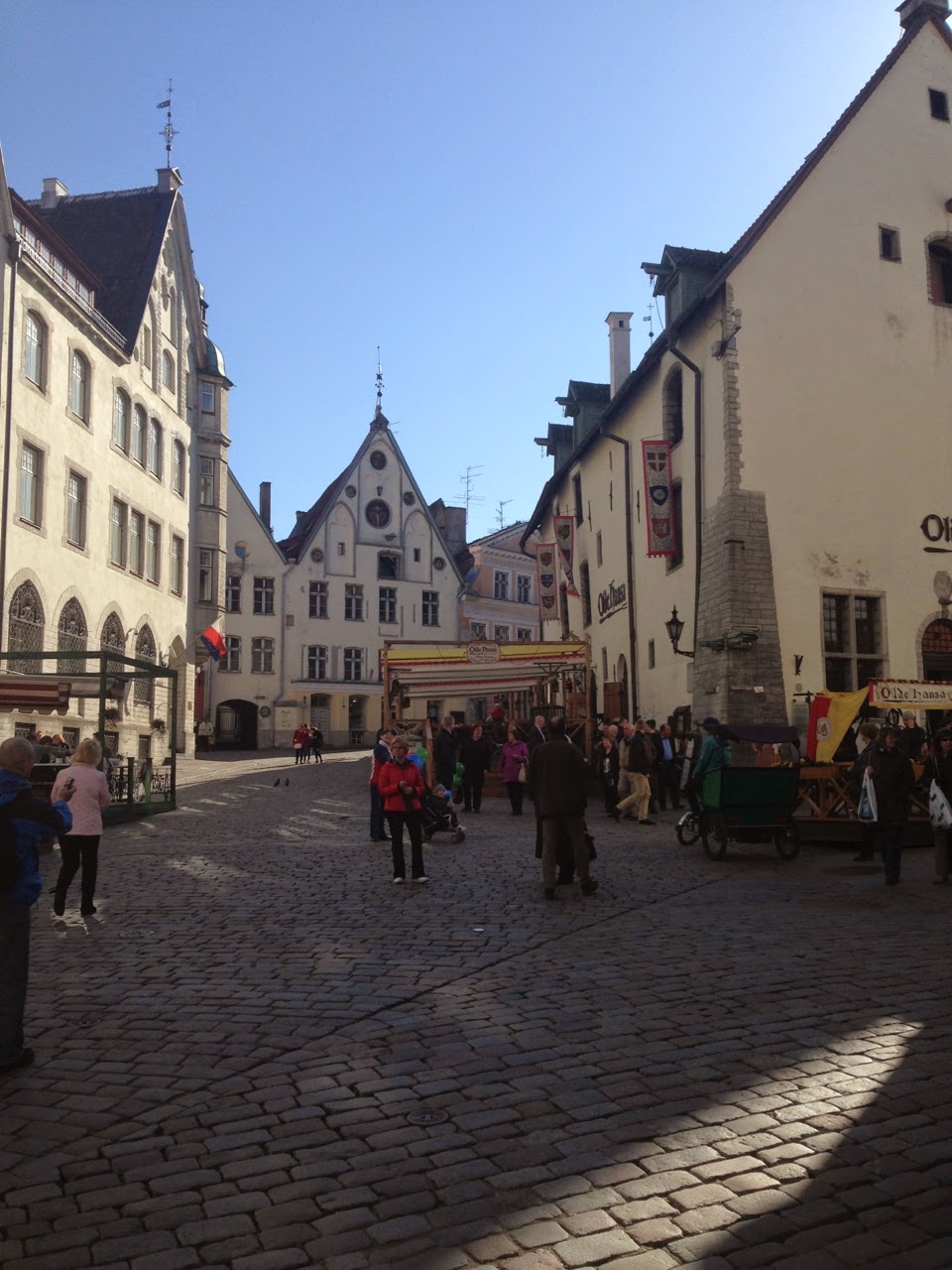
Tallinn Old Town

So, ah, back in the middle of May, before I cruelly abandoned my blog for WORK, the outrage, I had the happy opportunity to visit the beautiful city of Tallinn, capital of Estonia.  I was in Estonia (third new country of 2014, hurrah!) to attend the European Museum of the Year Award, which is inspiring and great and you should go if you have any interest in museums.  If you have any interest in beautiful old cities, you should visit Tallinn.  May is a wonderful time to be there because of the light: it doesn't get dark till late and everything has a special gilded quality.  

Tallinn  is a former Hanseatic city and its medieval Old Town is a World Heritage Site.  It's really a miracle of history that the old buildings survived the various invasions and occupations of the city (which included a change of name: the city was known as Reval for a chunk of its history).

As you walk through the walled centre, you'll see cobbled streets and houses with pointed gable roofs.


There are many references to Tallinn's medieval heritage, including guilds.  Behind this facade, a passageway led to Katariina Kaik, or St Catherine's Passage, which houses the Guild of St Katariina - a collective of craftspeople.


This is a teeny, tiny, Orthodox chapel,


while this is the spire of the Lutheran St Olaf's Church.


I found it a delight to walk around with no fixed itinerary: as the Old Town is bounded by walls, it's almost impossible to get lost.  Here's a view of one of the historic entryways to the city:


And here's the view from above:


Taking a turn, completely by whim, down Muurivahe, I discovered a door in one of the towers that led up to the ramparts.  (You had to pay a nominal amount - maybe €3 to enter).  Up at the top, I discovered my favourite spot in the city, and spent a happy hour there on a Sunday morning, basking in the sun, listening to the bells of the Old Town.

Wednesday 7 May 2014

The Trading Post


Home for our week in Lesotho was The Trading Post, Ha Baseane ('Ha' being the Sesotho word for 'place of', and 'Baseane' being a corruption of 'baas' (boss) John - after John Thorn who settled here in 1903) just outside Roma, where the national university is.  (And for my non-African correspondents you should get out of your head any concept of what a university town looks like: Roma is a collection of small houses, a handful of shops and some makeshift stalls.)


Here is the original Thorn homestead.  I spent many happy hours reading on the verandah, drinking coffee or gin, depending on the time of day.


Beyond the house is a series of rondavels: mud walled, thatched roofed, and retro-fabulously furnished.


Waking up at dawn every morning and hearing the birds singing was one of the most beautiful and joyful experiences of the trip.