Friday 20 November 2009

I'm Not Dead


Hints to Lady Travellers is speechless. Literally. I have no voice today and I very nearly decided that this was a sign I shouldn’t post anything today (I’m also behind on writing having spent two days in bed staring at the ceiling)….

But I know some of you check this blog not simply because you enjoy reading my stories but also to make sure that I’m still posting them and therefore am probably still alive.

I haven’t had time to make up a placard that says I’m Not Dead, instead, here’s a photo taken of me last night by one housemate (Beate) with another housemate (Thabi).

This was shortly before I decided to take advantage of my new husky voice by singing Lili Marlene, chanteuse-style on the verandah. Yes, I realise I have only myself to blame.

Bon weekend!

Thursday 19 November 2009

Irma Stern


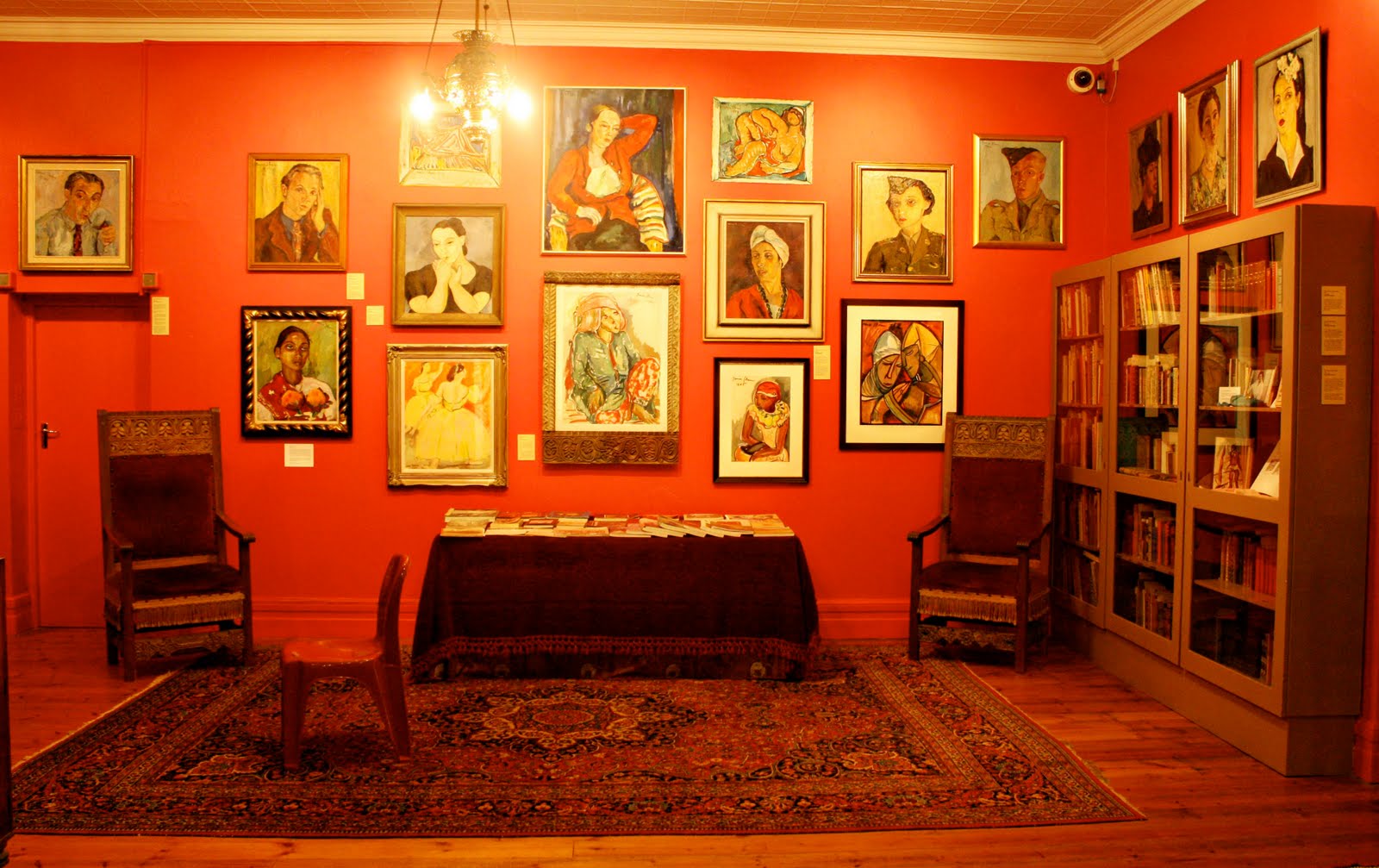
Thanks to a generous benefactor I had wheels on Saturday so I went for a little drive around. I stopped in Chelsea Village in Wynberg for a stroll and then I went to the Irma Stern Museum, which is now part of the University of Cape Town campus.

Irma Stern was a South African artist whose work perched her between Europe and Africa and who was, first, acclaimed in Europe before winning acceptance in her homeland.

The Museum is in the house where she lived. Looking at Irma Stern’s paintings in her house was a joy. No sterile white walls here. Anyone who paints her house in red, green, yellow, purple, blue gets my immediate sympathy.

I liked, very much, seeing where she had painted walls, doors and furniture – as though her painting slipped off the easel and spilled out into its surroundings. She also created signs and illustrations for books. Shelves full of the objects she collected, her books and interesting furniture give you a sense of her personality.

And I liked her work. Some of the portraits (especially of women) are a bit too stylised for my liking (can they all really have had such elegant, elongated cheekbones?) – but I like the way they stare at you from their frames.

And yes, there is something unmistakably African about them – enhanced by the fact that they’re displayed surrounded by art and artefacts Irma Stern collected on her travels through Southern Africa, the Congo and Zanzibar.

I know it’s not always possible, but the Irma Stern Museum makes a good argument for preserving artists’ houses as places to show their work. It’s just good sense.

Wednesday 18 November 2009

Choosing Words Carefully


I’ve been thinking a lot about this sign. It’s interesting to me that the English is so much more euphemistic with its ‘Europeans’, where the Afrikaans plainly says ‘Whites’. Where does that leave black Europeans or white Africans?

I grew up in what was, I would guess, one of the least racially diverse countries in Europe. I think that the result of this is that colour never played much of a part in my sense of identity. I never thought very much about my whiteness (except to bemoan the pale Irish skin that went purple in winter and pink in summer). And now I’m in South Africa where, for generations, almost every aspect of people’s daily lives was shaped by the colour of their skin. Learning about the careful definitions of colour created under the apartheid system – that are still very present – has been a wake up call for me.

I don’t begin to pretend to understand the complicated legacy of the apartheid era. But as with stories of other repressive regimes, two things never fail to astonish. The first is the lengths to which science and language were twisted to justify segregation and discrimination – and still there were holes in the system you could have driven a truck through. The second is that, despite all this, the system stayed in place for so long.

Tuesday 17 November 2009

Hidden in the Trees

Hints to Lady Travellers has been under the weather so has some catching up to do on writing about Capetonian adventures. In the meantime, she’s dug into her archives to present you with the following challenge.

What’s hidden in the trees?

Here’s a clue:

And another one:

Have you guessed yet?

The grey skies of last week have turned into skies of blue – summer is here! More soon.

Monday 16 November 2009

Hints to Taxis Riders in Cape Town

Adjust your mental image. I don’t mean the kind of taxi that you hail at a rank or call to collect you from your house. Picture a wide-bellied minibus with a yellow stripe round its middle. Picture hundreds of these hurtling along the streets of Cape Town. Welcome to public transport, South African style.


Going for a ride in a taxi is a cultural experience. Here’s how it works:

Where do you want to go?

The guy Norwegian Anne (Greatmore is nothing if not international) calls the animateur leans out the side, banging the roof and shouting the destination: Mow-breee* … Winey-winey-winey-WINEberg** … CAP-ty-oww***. If business is slow, he hops off to round up customers on the street.

Boarding

If you’ve decided that this is the right taxi for you, and there are fewer than 20 people crammed inside, you climb in. And often, over old ladies, shopping bags, small children, teenagers with long legs.

Fare

There is a flat rate of 5R to go pretty much anywhere. The animateur collects this in between touting for business. Because he’s so busy, everyone in the taxi is expected to pitch in and help collect the money and make change.

Where not to sit

I was warned never to sit in the front of a taxi with no conductor because you will have to do his job: shouting, banging, money-collecting and all.

The journey

The rules of the road are for other vehicles. Taxis overtake on the left (and the right and any direction they feel like). They use left-turn-only lanes when they’re blatantly going right. They rarely indicate. They have a loose tolerance for red lights. And strangely enough, this system works because all of the other cars on the road leave lots of space between themselves and the taxis.

Dismounting

When you get on, you tell the animateur where you want to get off. As you approach your chosen destination, you point out a likely landmark (for reference, I often go with Woodstock police station – sends a suitably stern message don’t you think?) The taxi screeches to the side, you climb over the other passengers and hop out. Or, in the case of one boy who was sitting next to me on the back seat, you climb out the window. Whatever works.

And, in conclusion

The taxis are strangely efficient. And cheap. And they make me laugh. So all in all, I rate them as a means of getting around. Cape Town – don’t sell yourself short. You do have public transport. A couple of weeks ago, I was at a presentation where two graphic designers presented their concept for a transport map that would include all the taxi routes. So next time you’re in Cape Town, you’ll be able to jump on a taxi too. Just don’t forget the right change.

*Mowbray **Wynberg ***Cape Town

Friday 13 November 2009

District 6


I was three weeks in Cape Town before I went to a museum.
This is a new record for me. But I chose something special to break my fast: District 6 Museum.

The background: in 1966, District 6* – just at the outskirts of Cape Town city centre – was declared a White Group Area. The mostly black and coloured inhabitants were forcibly removed and their homes demolished. The Museum tells their stories – of what life was like in District 6 before 1966, the removals and demolition, and finally the post-1994 efforts to compensate the people who lost their homes and to revive the area.

The good: the museum narrative is composed of memories. Almost everything is explained through the memory of someone who actually lived through the demolition of District 6 and lost everything.

A lot of the displays have an art installation feel (in a good way) like this one which creates a tower out of the street signs of District 6 with earth from the site at the bottom:

There is hardly any didactic/informative text, apart from a timeline.** Though I would have liked an introduction, there is no doubt that hearing the stories first hand creates a very powerful emotional experience. The Museum uses lots of sound – mostly first person testimonies but also music – very effectively. I also like the way objects and photographs were layered onto plans and maps since so much of the museum is about mapping memories onto place: the District 6 that has vanished, the wasteland that’s there now and the vision for its redevelopment in the future.

The bad: the Museum isn’t perfect. Of course it isn’t – no Museum is. With my museum design goggles on I have three main gripes. First, it would be helpful to have more of an overview at the beginning to understand the Group Areas Act and its context. Second, there is a lot of text and most of it is very small. Third, the circulation is a bit convoluted and involves backtracking a few times.

The ugly: I was surprised at how upset I was during the visit. But District 6 Museum is a reminder to me of how powerful museums can be. You might know about the past, but there is nothing like being in the presence of the physical evidence to bring it home.

A note on the sponsors: I was surprised but pleased to see that the Irish Government had supported the Museum. Money well spent.

*Not to be confused with District 9, a movie about aliens settling in a township in Johannesburg.

**I hate timelines usually (in fact, every exhibition designer I know spits when they say the word) but this one was useful to give some background. Unfortunately it was in wee tiny font running along the bottom of the panels.

Thursday 12 November 2009

The Photographer Photographed

First of all there was the Mean Face.

Now I can’t stop taking pictures of myself in mirrors (or windows if I'm feeling especially arty).

Why? I really don’t know. It’s not as though any of them are particularly flattering. But it’ll be useful evidence to prove that I really was here.